Oxford MIPAS meeting#105
31 October 06

Present

Instrument Status [Prev] [Next]
Envisat problem with Ka band antenna continues (details on the Envisat Web-Site) although they are now sending the high-bit rate data from SAR and MERIS (which, presumably, could not be stored on board until the Svalbard overpass) via Artemis and hope to resume this route for all data from mid-November.

MIPAS itself continues in a long sequence of nominal mode observations 2 orbits on followed by 3 orbits off (intended to be tested as an input for ECMWF data assimilation).

MIPAS QWG-11 Meeting (Bologna 24-25 Oct 06) (JW) [Prev] [Next]
[Minutes] (.pdf) from Thorsten Fehr, 24Nov06.
Oxford Presentations (.ppt files)
Notes from the L2 part are [below]

RR27 pT Retrieval (AD) [Prev] [Next]
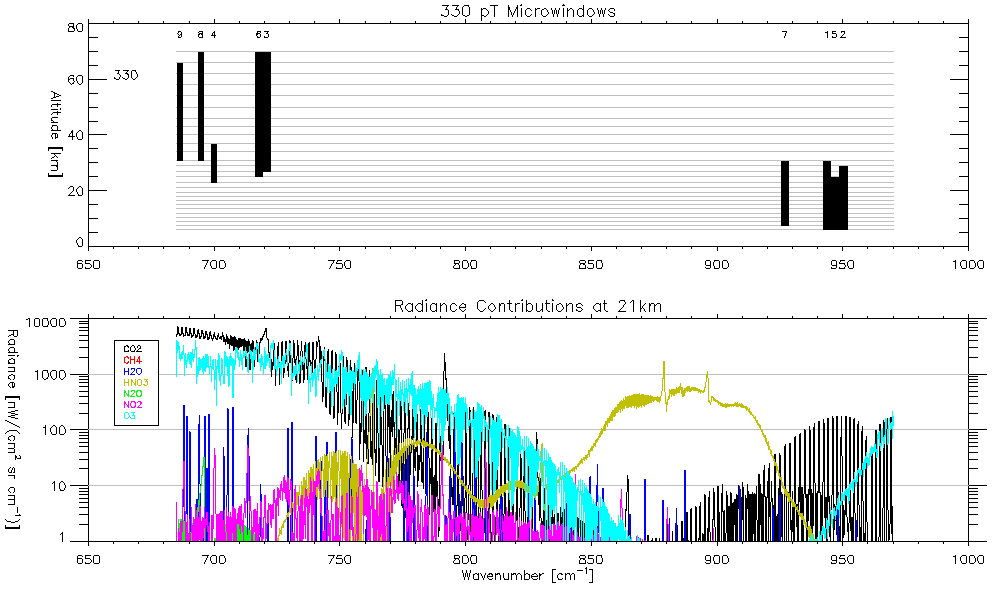
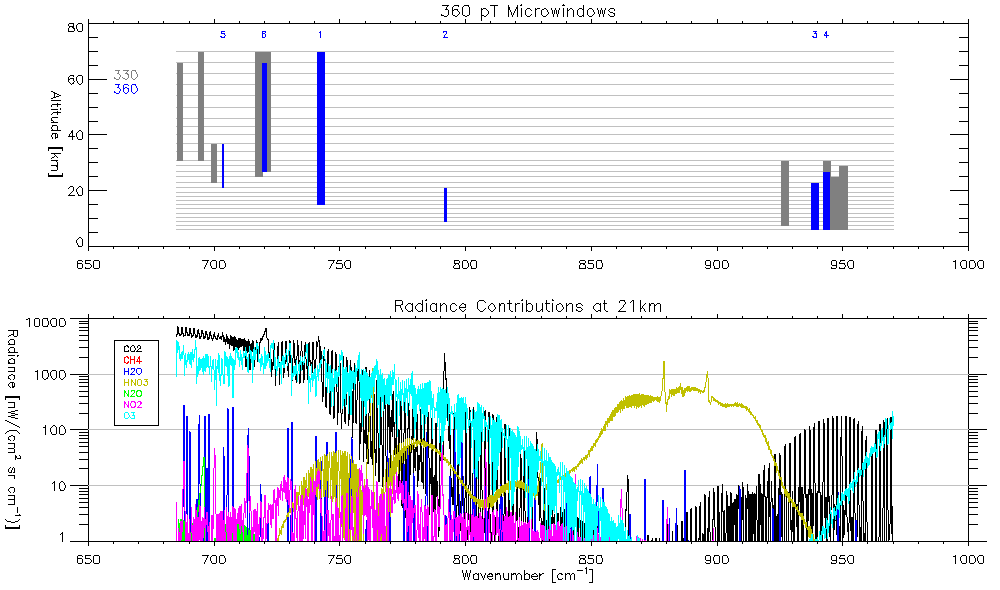
The original '330' selection [Plot] had a discontinuity at 21km where microwindows switched from 940cm-1 region (low altitudes) to longer wavelengths

TES Radiance Comparisons (CW) [Prev] [Next]
Continuing with comparison of MIPAS and TES limb radiance spectra from Jan 28 2005 using regions where the MIPAS bands and TES filters overlap

CO Retrievals (JW) [Prev] [Next]
Continuing with a joint retrieval of CO and vibrational temperature using RFM being used in non-LTE mode as a forward model within IDL retrieval program
  • Still using simulated data but problems with representing structure of VT profile above top retrieval level.

    Cloud Parameters (JH) [Prev] [Next]
    Attempting to retrieve both Cloud Top Height and Cloud Extinction using a pair of adjacent sweeps (the cloud top being in the FOV of the upper sweep).
    • Currently using RFM simulated spectra to try and find out if basic equation describing semi-transparent, non-scattering, uniform, flat-topped cloud radiance is correctly coded

    Mesospheric Spectra (LMV) [Prev] [Next]
    Analysing contents of MIPAS mesospheric spectra (52, 60 and 68km nominal altitudes).
    • Having removed lines of all the expected molecules (CO2, key-species, CO and NO), there remained a noticeable feature attributable to CF4, plus aliassing spikes.
    • Having removed these, there are still some unexplained "line-like" features in the D-band - these may just be residual signals at spectral points adjacent to those masked out as contaminated by known gases (NO+ was also a possibility, but the line positions don't match those in HITRAN)
    • [Plot] shows, in yellow, the averaged MIPAS spectra for the 3 tangent altitudes. The same [Plot] but with an expanded y-scale shows, in black, the residual spectra after all known molecular contributions have been removed and the red line a smoothed version of the residuals. Note that there still seems to be a residual NO2 signature at 1600cm-1, and the remaining "line-like" features around 2300cm-1.

    ACVE-3 Workshop 4-7th Dec, Frascati [Prev] [Next]
    Website: www.congrex.nl/06m25/
    Although the official deadline for abstracts was a couple of days ago, the website says that late submissions will be accepted up until 24th November
    ESA will attempt to generate some RR27 L2 retrievals using the ML2PP prototype processor in time for this meeting, but it will be tight depending, for example, on whether the latest set of pT microwindows are acceptable.
    Not yet submitted anything from Oxford, but thinking of submitting some MIPAS posters on
    • Microwindow selection for RR (A Dudhia)
    • Mesospheric Spectra (Luis Millan Valle)
    • Precision Validation (Chiara Piccolo)

    RAL Work (AW) [Prev] [Next]
    Looking at the RAL line-by-line model (originally developed for the microwave region) as a prelude to using the RAL 2D retrieval.

    ACPD Papers [Prev] [Next]
    Papers selected from the ACPD website for discussion
    "A study of polar ozone depletion based on sequential assimilation of satellite data from the ENVISAT/MIPAS and Odin/SMR instruments"
    J. D. Rösevall et al (submitted 10.10.2006, open until 05.12.2006)
    Introduced by CW.
    "An annual cycle of long lived stratospheric gases from MIPAS"
    by M. N. Juckes (submitted 26.09.2006, open until 21.11.2006)
    Comments being collected by AD
    " Reflection and transmission of solar light by clouds: asymptotic theory"
    by A. A. Kokhanovsky & T. Nauss (submitted 31.08.2006, open until 26.10.2006)
    Comments submitted by JH. Discussion now closed.
    There are several more MIPAS-related papers currently open (which may be adopted for group discussion in future meetings)
    "MIPAS Level 1B algorithms overview: operational processing and characterization"
    A.Kleinert et al. (submitted 26.10.2006, open until 21.12.2006)
    "Evaluation of ozonesondes, HALOE, SAGE II and III, Odin-OSIRIS and SMR, and ENVISAT-GOMOS, -SCIAMACHY and -MIPAS ozone profiles in the tropics from SAOZ long duration balloon measurements in 2003 and 2004"
    F.Borchi et al. (submitted 11.10.2006, open until 06.12.2006)
    "Detection of organic compound signatures in infra-red, limb emission spectra observed by the MIPAS-B2 instrument"
    J. J. Remedios et al (submitted 11.10.2006, open until 06.12.2006)
    "Validation of MIPAS ClONO2 measurements"
    M. Höpfner et al (submitted 05.10.2006, open until 30.11.2006)
    "Validation of nitric acid retrieved by the IMK-IAA processor from MIPAS/ENVISAT measurements
    D. Y. Wang et al (submitted 05.10.2006, open until 30.11.2006)

  • Joanne Walker's notes from the L2 section of the QWG11 meeting

    Continuum anomaly (Fabrizio Niro)
    L2 processor fits continuum even above 20km where it should not be part of the state vector. Problem has now been fixed.

    L2 data missing around South Pole in July-November 2002 (Fabrizio Niro)
    Top sweep altitude higher than 72 km limit defined in OM. This is due to a latitudinal dependence of pointing and also due to a yearly oscillation in the pointing due to the platform changing position. To be fixed in version ml2pp 5.00.

    ml2pp status
    New formula for estimating tropopause height has been implemented for use with floating altitude grid.

    AI_L1_10.23. Investigate L2 retrievals of gain
    Gain has a large effect on retrieved quantities. Propose to perform a joint retrieval of pT, radiometric gain, H2O etc. However, difficult to implement and results are uncertain. Large error on gain. Suggested by Anu Dudhia that we should compare the gain of forward and reverse sweeps over an entire day. Atmospheric contribution should cancel between sweeps and we might at least get an idea of the change in gain between forward and reverse sweeps.

    Optimum times to decontaminate
    Optimum measurement and decontamination times determined by trade-off between not wasting good measurements through unnecessary decontamination and decontaminating before the decrease in gain due to ice formation becomes too great. Was suggested that twice per year may be sufficient. Was noted that the interferometer does not infact perform better (mechanically) immediately after decontamination as has been previously suggested and that this is not an additional factor to be considered.

    Investigations into ILS error characterisation (Piera Raspollini)
    Correlation between the residuals and 2nd derivatives of spectra. Some of this appears to be explained by the truncation of the apodisation function, although not clear why this should be (main 2nd derivative signature is from the width of the main peak of the AILS, not the ripple several grid points away).

    Level 2 tests on selected microwindows (Simone Ceccherini)
    Use L1B file from BOMEM for orbit#10789 at 0.0250 cm-1. Compare retrievals with those from simulated L1B file at 0.0625 cm-1. Look for systematic differences between retrievals at each resolution. Using RR microwindows for pT 331-335, temperature is significantly higher at 21 km. From OM evident that we are using only CO2 laser band pT microwindows at and below 21 km. This is related to the anomalous temperature at 21 km. Also seen in mean of RR orbit#17540. Anu Dudhia has supplied extra MW's (342 and 343) around 21 km at shorter wavelengths. Temperature anomaly disappears but retrieval is more unstable.

    pT microwindows (Anu Dudhia)
    RR17 (August 2004) pT MW's extend down to low altitudes in CO2 laser band. RR27 have many more MW's in CO2 laser band at low altitudes. However, more MW's required in 700-750 cm-1 region. H2O and O3 included in MW selection at retrieval uncertainty as opposed to climatological uncertainty in an attempt to persuade MW selection to go down to low altitudes in this region, (mw_350.lst). More overlap but still not enough. Will attempt to constrain MWMAKE to find MW's in this region before laser band.

    GMTR New resolution measurement scenario (Enzo Papandrea)
    Using orbi#17540. MTR of pT, H2O and O3 using MW's selected with MWMAKE. Vertical oscillations seen in mid-latitude and polar scans in CH4 and N2O, as expected when oversampling FOV. However, most species are unaffected.

    Analysis of NO2 residuals at high resolution, old nominal scenario (Marco Ridolfi)
    Addressing problem of high NO2 at 68 km under conditions where it should be negligible. Microwindows include a badly modelled H2O line at 1609.44 cm-1. Problems intepreting results since NO2 profiles are all interpolated to a fine altitude grid.

    Detection of H(15)NO3 in MIPAS spectra (Gabriele Brizzi)
    Use 870.0-871.5 region in Band-A. As signal below noise, compare averaged specra with simulated spectra. Compare spectra with and without v5 Q-branch. Using REC analysis, a significant contribution from "continuum" signature is attributed to CFC-12, although unlikely that CFC-12 concentration is at fault - more likely just an unmodelled atmospheric continuum.

    MIPAS ozone validation co-ordinated activity final results (Ugo Cortesi)
    Generally good agreement between MIPAS and other instruments.

    Cloud detection and reference atmospheres (David Moore)
    Using NESR and assuming errors are random, errors from each MW used in cloud indexing add in quadrature. Suggested that error could be reduced by increasing the size of the cloudy MW but there is a trade-off with the introduction of interfering species.

    Anomalously high H2O and O3 could be residual cloud. CI thresholds of 1.8 can result in O3 errors of 20 % at 12 km and H2O errors of 70 % at 15 km in tropics. Cloud at 12 km can cause errors at the 15 km level. Suggested to change CI from 1.8 to 2.3 for O3 and to between 2.3 and 2.6 for H2O in tropics.

    When changing from FR to RR grid, CI changes by up to around 20 % in Band-D. CI in bands A and B show little change < 2 %.

    Mostly good agreement between MIPAS monthly mean and IG2 climatology. Standard sigma on IG2 less than atmospheric variability from MIPAS.

    NLTE (Manuel López-Puertas)
    N2O - NLTE in 4.5µm band. Seen when comparing day and nighttime spectra using equivalent latitudes.

    CO - Looking around 4.7µm. Hot band (2-1) sensitive to reflection from surface and clouds. Differences between Fundamental band LTE nighttime and NLTE nighttime emission. LTE overestimates CO in mid-upper stratosphere by 15-20 % and by 100 %in mesosphere. This is due to the low collision rates meaning molecular energy levels are not thermalised. Where atmosphere is optically thin there is spontaneous emission to space. At night this results in NLTE temperatures lower than LTE temperatures.

    Solar storm January 2005: NO, NO+ and CO2 - GOES shows solar proton flux. Around 12 hours later we see the atmospheric effect. Examine 21st and 22nd January 2005. Integrate radiance over NO bands at 120 km. Examine radiances with latitude and height. See big increase in radiance at poles after storm hits. Spreads to equator in around 2 hours. NO+(1-0) integrated radiances increase by 20-100 % after storm in SH summer. CO2 radiances increase by factor 2 in same region.

    Noctilucent clouds in SH 2005 - Examine 19-21st July 2005. Average around 4000 scans from these dates. See increase in radiance associated with NLC's at 80 km poleward of 80N. Orbit 17704 shows most significant enhancement due to NLC's. However, would be difficult to extract any information about NLC's from these spectra.

    Temperature and LOS retrievals (Anne Kleinhert)
    Temperature retrieval shows no signs of systematic errors at RR.

    Ethane (Jean-Marie Flaude)
    HITRAN cold band too large by a factor 2. HITRAN scaled by 0.62 produces the best fit at 278K. Need to fit PNNL spectra also at 298 and 313 K to check T-dependency.

    MIPAS temperature validation (Marco Ridolfi)
    Perhaps cloud flagging needs to be more conservative.

    Validation of MIPAS NO2 operational data (Gerald Wetzel)
    ESA NO2 is higher than the IMK/IAA results at high altitudes especially in the polar night. Perhaps due to the column above retrieval being accounted for in top retrieval level.