Oxford MIPAS meeting#128
13 Nov 07

Present

Instrument Status [Prev] [Next]
11-20th Nov: new "standard" 10 day cycle of observations: 3 days NOM, 1 day MA, 1 day UA, 3 days NOM, 2 days off
20th-29th: repeat 10 day cycle

L1B Data (JH) [Prev] [Next]
L1B coverage maps updated to Oct 27th

Oxford L2 Processing (AD) [Prev] [Next]
Running MORSE to retrieve our own L2 data: pT, H2O, O3, HNO3, CH4, N2O, NO2, CFC-11, CFC-12, ClONO2, N2O5 and CO (LTE assumption)
Currently processing
  • all recent data with a lag of around 1 month (2 weeks for L1B data to appear, plus 2 weeks for L2 processing) - most recent day Oct 17th
  • Backlog of any missing data since June 1st 2007
  • All remaining Jan 2005 data (for Solar Proton Event)
  • Oct 2002 data for comparison with this year

    MIPAS - HIRDLS Comparisons (CW) [Prev] [Next]
    [Plots] showing updated version of MIPAS (Oxford L2) v latest version of HIRDLS L2 Products (here, just for 20-60N, 28JAN05, Tem, H2O and O3)
    HIRDLS precision values are unrealistically small, so using HIRDLS v MIPAS SD about zonal mean to try to derive actual values (on the assumption that the atmospheric contribution to the SD is the same in both cases).
    • [Plot] of MIPAS(Red) & HIRDLS(Blue) for various molecules, HIRDLS - outer error bars are SD of zonal mean, inner error bars are average precision from L2 data.

    Polar Stratospheric Clouds (JH) [Prev] [Next]
    Trying to use SVD techniques to distinguish different types of PSC
    • Run cloud retrieval to identify all clouds with Cloud Top Temperature < 200K in Antarctic region
    • Fit clear sky SVD components to leave cloud residuals
    • Perform further SVD analysis of residuals to see if different patterns emerge
    Results of a limited number of cases of cloud tops at 15km altitude for 2 weeks in Aug 03 seem to fall into 3 distinct patterns.

    Mesospheric Retrievals [Prev] [Next]
    Reviewing progress with linear retrieval model
    • level-by-level retrieval v global fit
    • fitting temperature only v pressure-temperature
    • retrieving Planck function v fitting temperature
    Fitting temperature rather than Planck function seems to produce better results, which is surprising since radiance should be a more linear function of B than T, but this may be because of the manner in which the Planck function is defined, ie at a single wavenumber rather than for each spectral point within the A band.

    2007 Antarctic Spring (AD) [Prev] [Next]
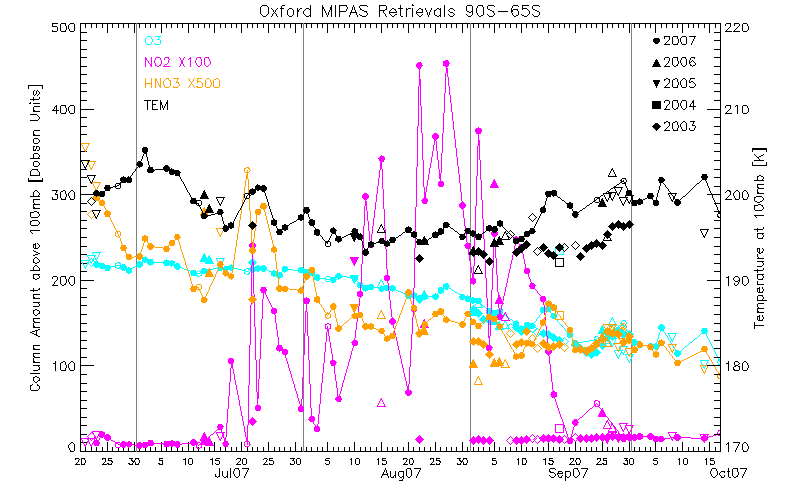
    [Plot] showing last 100 days (up to 17 Oct 07) for 65S-90S as observed in Oxford retrievals], compared with data retrieved for previous years.
    • Since mid-September Temperature has started to rise again
    • Ozone continues to fall, in line with previous years
    • Large NO2 concentrations lasted from mid-July to mid-September, but now back to normal levels
    • HNO3 continues to fall

    ASSFTS-13 Workshop (AD) [Prev]
    Toulouse, 7-9 Nov 2007
    www.meteo.fr/cic/assfts13/

    CO Retrievals (JW) [Prev] [Next]
    Returned from visit to IAA looking into how to improve CO retrievals by better constraining the (a priori) vibrational temperature profile.
    • Approach will be to try to parameterise vibrational temperature profile based on off-line model calculations as a function of SZA, kinetic temperature and (?) CO profile.

    ACPD Papers [Prev] [Next]
    Papers selected from the ACPD website for discussion
    "Characterizing mega-city pollution with TES O3 and CO measurements"
    C. Shim et al. (published 25 Oct 2007, open until 20 Dec 2007)
    Introduced by CW
    "The wintertime two-day wave in the Polar Stratosphere, Mesosphere and lower Thermosphere"
    D.J.Sandford et al. (published 16 Oct 2007, open until 11 Dec 2007)
    Comments being collected by LMV
    "Global distribution of mean age of stratospheric air from MIPAS SF$_6$ measurements"
    G.P.Stiller et al. (published 18 Sep 2007, discussion now closed 13 Nov 2007)
    Comments were being collected by JW but not submitted in time.
    Other MIPAS-related papers in the Open Discussion phase, which may be adopted at a future meeting
    "Retrieval of global upper tropospheric and stratospheric formaldehyde (H2CO) distributions from high-resolution MIPAS-Envisat spectra"
    T.Steck et al. (published 18 Sep 2007, discussion now closed 13 Nov 2007)
    "MIPAS: an instrument for atmospheric and climate research"
    H.Fischer et al. (published 25.06.2007, open until 11.09.2007)