Oxford MIPAS meeting#129
27 Nov 07

Present

Instrument Status [Prev] [Next]
20-29th Nov: standard "80%" 10 day cycle of observations: 3 days NOM, 1 day MA, 1 day UA, 3 days NOM, 2 days off
1st-10th December: start of new standard cycle for continuous operations: 8 days NOM, 1 day MA, 1 day UA.

L1B Data (JH) [Prev] [Next]
L1B coverage maps updated to Nov 12th (or will be shortly...)

Oxford L2 Processing (AD) [Prev] [Next]
Running MORSE to retrieve our own L2 data: pT, H2O, O3, HNO3, CH4, N2O, NO2, CFC-11, CFC-12, ClONO2, N2O5 and CO (LTE assumption)
Processing all new data with a lag of around 3 weeks (2 weeks for L1B data to appear, 1 week to process L2 locally)
Also processing all previous Oct/Nov data (2002-2006) to provide comparison with recent data

MIPAS - HIRDLS Comparisons (CW) [Prev] [Next]
Comparing MIPAS and HIRDLS SD of zonal mean profiles in order to evaluate the HIRDLS precision (precision values assigned to HIRDLS L2 data are known to significantly underestimate actual values
However, plot of Temperature SD for 28Jan05, 20N-65N (page 1 of plots, dashed lines, Red = SD of MIPAS temperatures, Blue = HIRDLS temperatures), shows a curiously regular structure measured by both instruments, so likely to be an atmospheric feature rather than instrumental
What causes the atmospheric temperature variability around a longitude circle to have such regular structure?

Polar Stratospheric Clouds (JH) [Prev] [Next]
Trying to use SVD techniques to distinguish different types of PSC
Unfortunately, no clear correlation occurs between any particular cloudy singular vector and the PSC types identified using the IMK algorithm

Mesospheric Retrievals [Prev] [Next]
Attempting to establish upper and lower altitude limits of validity of linear pT retrieval assumptions
The linear retrieval is intended to allow large spectral ranges to be used, eg most of the A band, however there is a technical problem when trying to construct the inverse of the apodised NESR covariance matrix - a band diagonal matrix of order several thousand. There ought to be an efficient method to do this.

2007 Antarctic Spring (AD) [Prev]
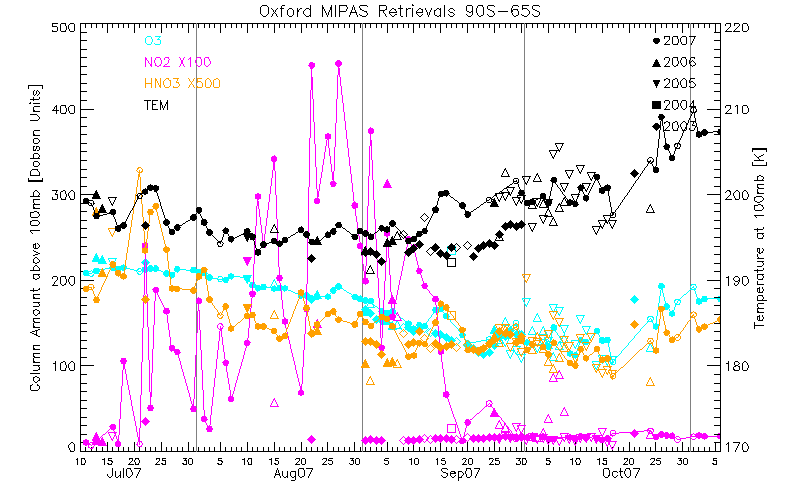
[Plot] showing last 120 days (up to 6 Nov 07) for 65S-90S as observed in [Oxford retrievals], compared with data retrieved for previous years.

CO Retrievals (JW) [Prev] [Next]
Investigating how to incorporate non-LTE effects into a practical (i.e. near real time) operational scheme to retrieve CO
Current approach being tested is as follows

ACPD Papers [Prev] [Next]
Papers selected from the ACPD website for discussion
new paper to be selected by JH - not yet decided which
"Characterizing mega-city pollution with TES O3 and CO measurements"
C. Shim et al. (published 25 Oct 2007, open until 20 Dec 2007)
Comments being collected by CW
"The wintertime two-day wave in the Polar Stratosphere, Mesosphere and lower Thermosphere"
D.J.Sandford et al. (published 16 Oct 2007, open until 11 Dec 2007)
Comments being collected by LMV
Other MIPAS-related papers in the Open Discussion phase, which may be adopted at a future meeting
"Technical Note: Intercomparison of ILAS-II version 2 and 1.4 trace species with MIPAS-B measurements"
G. Wetzel et al. (published 22 Nov 2007, open until 17 Jan 2008)