Oxford MIPAS meeting#76
7 Jun 05

Present

Instrument Status [Prev] [Next]
Some details on the Envisat Web-Site including Instrument Availability web-site
Latest version of Mission Planning Document (from Marta de Laurentis) covering 1 Jan 05 to 11 Jul 05:
Recently switched off for decontamination (23 May - 01 Jun) and should have restarted observations on 03 Jun taking 4-5 orbits per day with the nominal scan pattern to support the Teresina campaign (Brazil).
See Message from Rob Koopman

L1 Data [Prev] [Next]
[BADC Archive of reprocessed L1B Data]

L2 OFL Data [Prev] [Next]
[Plots of profile locations]

HiRDLS Comparisons (CW) [Prev] [Next]
Starting to compare MIPAS and HiRDLS Radiances for 28th January 2005 (day since start of HiRDLS operations with best available MIPAS coverage - 3 orbits) [Plot - HiRDLS scans in blue, MIPAS in red]

2RR Microwindows (ie 0.0625cm-1 resln) (AD) [Prev] [Next]
Selecting microwindows for new nominal mode operations which employ floating altitude grid (lowest altitude 3-9km from pole-equator) and 1.5km spacing at lower altitudes

NO2 Retrievals [Prev]
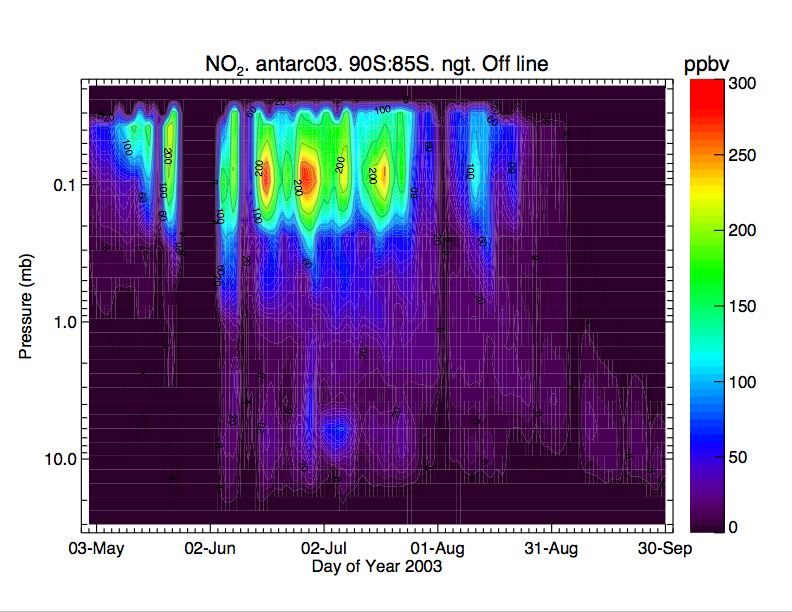
Manuel Lopez-Puertas (IAA) sent the following message (30 May)
As you probably know we are analyzing the NO2 in the different polar winters that MIPAS have measured. I have plotted a time series of the NO2 data you recently sent me for the antarctic hemisphere ([see fig. attached). I am suspicious about the high NO2 values that we retrieved at 20-3 mb from 2 Jun until 1st august. NO2 reach values as high as 60 ppmb at 6-7 mb ~4 July, which we find difficult to explain from an atmospheric point of view. Could it be a propagation error from the very high values at ~0.1mb together with the very cold temperatures at ~10mb pressure levels? Could you or perhaps somebody at Florence have a look at the chi2 values for this period?
We note that this feature was also observable in the NRT data for that period, averaged from 65N-90N (nighttime but not daytime): [Plot] - a secondary peak at 30km. Our suspicion is that it is a retrieval artifact related to
  1. the high NO2 values in the mesosphere, and/or
  2. the fact that 30km is also the top of the continuum retrieval

RAL Work (AW) [Prev] [Next]
Currently running MORSE on S6 mode data

Software Updates (AD) [Prev] [Next]
Our local L1C format has been modified: v2.0

ASSFTS-12 Workshop (Quebec, 18-20 May 2005) [Prev] [Next]
Website http://bernath.uwaterloo.ca/ASSFTS/ should eventually include all posters/presentations.
In the meantime, here are the Oxford contributions:

Message from Rob Koopman (ESRIN) 7th Jun 05
Subject: Decontamination status

Dear all,

Roberta and Gaetan have performed the first gain calibration since the decontamination.

The radiance reaching the detectors is 200% of that prior to the decontamination, showing that a large amount of contaminant has sublimated. As for previous decontaminations, the radiance levels are now identical to that at beginning of mission, so the Teresina campaign will benefit from optimal throughput.

We will continue to carefully monitor the growth rate of the contamination. My thanks to all involved for the accurate duration calculations, and the punctual execution.