|
 |
 |
 |
 |
 |
 |
 |
 |
 |
||
 |
 |
||||||||||
|
|
|
|
|
|
|
|
|
|
||
|
|
||||||||||
Volcanic Ash Spectroscopy
IntroductionUnderstanding the role of volcanic ash in atmospheric chemical reactions and radiative transfer is important in understanding the composition and behavior of the Earth's atmosphere. Aerosol particles alter the visible and UV flux through the atmosphere by scattering solar radiation, and by absorbing infrared radiation. In the troposphere ash particles additionally act as cloud condensation nuclei and so have an indirect effect on the radiation budget by modifying the radiative properties of cloud. In the stratosphere, the particles may become coated with sulphuric acid so they increase the effective amount of sulphuric acid aerosol surface area available for heterogeneous reactions. Several jet airplanes have been damaged by encounters with drifting clouds of volcanic ash in air routes. Casadevall (1994) reported 80 cases in the previous 20 years. The natural variability of volcanism implies that there will be high year-to-year variability about the average. At least two commercial passenger aircraft have had all engines fail following flight into an unanticipated volcanic ash cloud during those 20 years (for example BA flight 9). Most aircraft ash encounters occur where the volcanoes are relatively isolated. Remote sensing of such volcanic ash clouds from satellites and ground based measurements is possible. To enable accurate identification of the ash knowledge of the spectral signature of the ash is essential. The spectral signature of the ash contains information on the ash particles size, number density and composition. In addition the ash could be coated in water, ice or sulphuric acid. As part of a NERC funded project the spectral signature of volcanic ash has been measured at the NERC Molecular Spectroscopy Facility at the Rutherford Appleton Laboratory. The volcanic ash sample analysed was provided by Dr Tony Hurst who collected the sample from a 'bomb shelter' on the slopes of the Mt Aso volcano in Japan. In summary, the ash cloud generated by a volcanic eruption perturbs atmospheric radiation and chemistry and is potentially dangerous to aircraft. Quantification of the effect of an ash cloud requires knowledge of its composition, its optical properties and of properties of the particle size distribution (number density, effective radius, surface area density and volume density). MethodThe ash samples are re-dispersed to generate an ash aerosol. The resulting aerosol is passed into an optical cell where the spectral transmission is measured by a Fourier transform spectrometer. These measurements of the optical transmission are then inverted for the particles refractive index and size distribution. To enable this inversion to take place the spectral dependence of the refractive index must be simplified to reduce the number of parameters, and scattering is modeled using Mie theory. This is achieved by the use of a simple harmonic oscillator model of the refractive index. Details of this method can be found in Thomas 2005. This method has also been applied to derived the refractive index for salt aerosols (Irshad 2009). Results
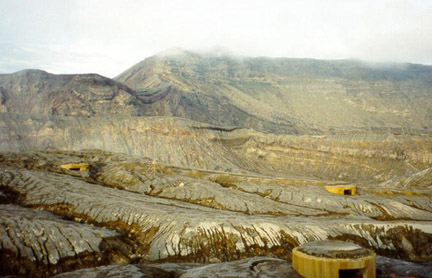
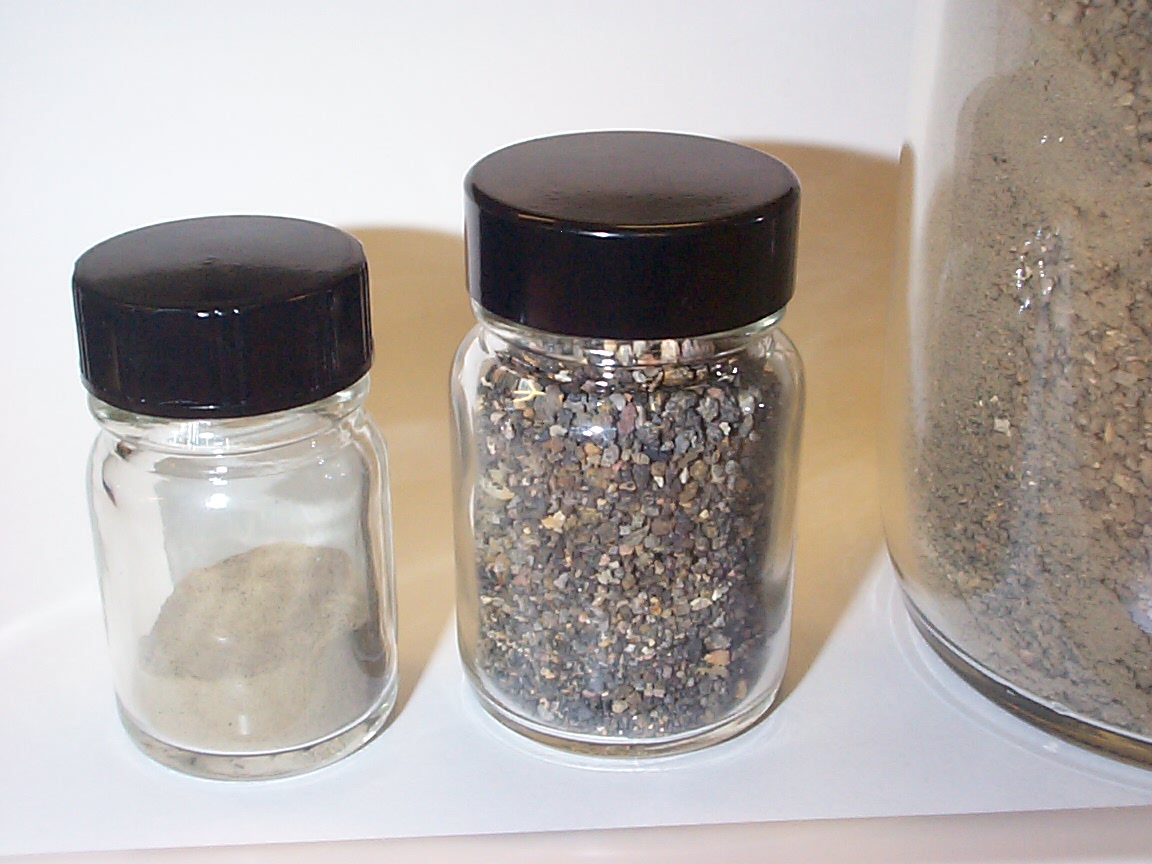
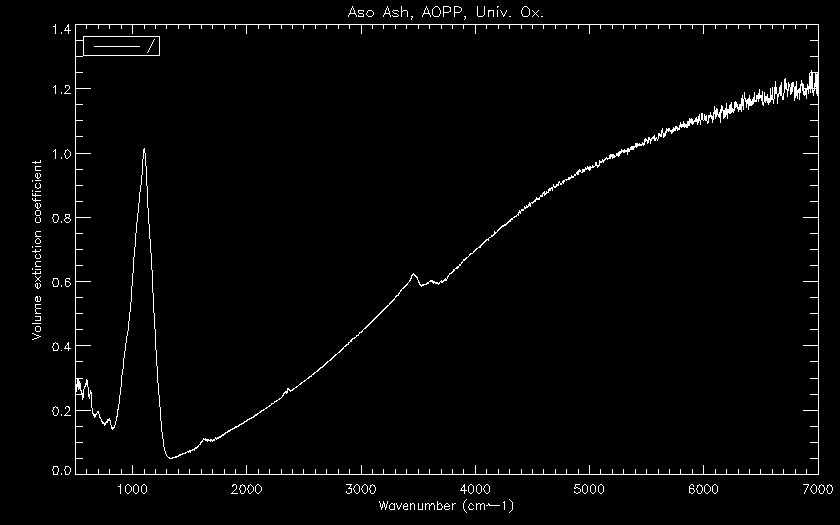
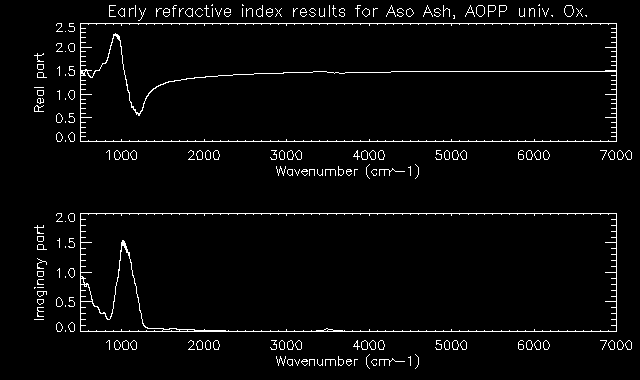
The sample used is a volcanic ash sample, collected from the Aso volcanic eruptions in 1993. This sample has been collected from a bomb-shelter where 1 m to 2 m of ash accumulated, and is hence in as fresh a state as possible. Once dispersed into the MSF aerosol cell, we obtained an absorption spectra. An example is given in Fig. 1. On applying the method of Thomas 2005 the refractive index and particle size distribution was obtained. And example of the refractive index derived in shown in Fig. 2. Future workThe above spectra will be applied to remote satellite retrievals of ash clouds, and early results are promising. Ideally we would also repeat these experiments for a number of different volcanic eruptions as the spectral signature will change as the chemical composition of the ash for each eruption is different. We would like to extend the measurements into the visible and ultra-violet as this would be of great use for instruments such as lidar. With the latest Icelandic eruption of Eyjafjallajökull and disruption air transport there is clearly a need to improve the detection and quantification of volcanic ash clouds.Links and referencesCasadevall, T.J. (Ed.), Introduction to Volcanic Ash And Aviation Safety, Proceedings of the 1st International Symposium on Volcanic Ash and Aviation Safety, USGS Bulletin 2047, 1994. Irshad R., R.G. Grainger, D.M. Peters, R.A. McPheat, K.M. Smith, G.E. Thomas, Laboratory measurements of the optical properties of sea salt aerosol, Atmos. Chem. Phys., 9(1),221-230, 2009. Thomas, G. E.; Bass, S. F.; Grainger, R. G. & Lambert, A. Retrieval of aerosol refractive index from extinction spectra with a damped harmonic-oscillator band model APPLIED OPTICS, 2005 Please contact us before reproducing these images elsewhere, or if you have further questions. |
Maintained by Dan Peters and Don Grainger | Contact us